| Artist | City wall or location | Method or signal | Planning use |
|---|---|---|---|
| Banksy | Stencil on a Jerusalem wall, 2003 | Spray cans and stencils prepared before painting | Use as the reference point for stencil work, and look for his pieces by city and surface. |
| Shepard Fairey | Marianne mural in Paris, 13th district | Sticker campaign with the face of André the Giant, stuck more than a million times | Choose for the move from repeated stickers to a single large civic mural. |
| Keith Haring | New York subway walls; Philadelphia mural, 1987 | Chalk drawings in the subway; a mural painted with 14 high school students | Choose for public, readable work made with communities as well as alone. |
| Jean-Michel Basquiat | Lower Manhattan, late 1970s | Cryptic, poetic slogans tagged under the alias SAMO | Study the district rather than one address, because the tags spread across lower Manhattan. |
Locations and methods in the table come from Artsper’s list of famous street art and Maddox Gallery’s overview of street artists.
Famous street artists such as Banksy, Shepard Fairey, JR, Keith Haring and Jean-Michel Basquiat are best understood through the city walls they worked on, not only through the galleries that later collected them.
Those walls sit in different cities, so decide whether you are following one artist or one place. Our guide on how to find street art in a city helps with the second approach.
Artists and the city walls tied to them
Each of these artists is linked to a specific kind of surface and a specific city. Knowing the pairing tells you where to look and what kind of work to expect.
Banksy: stencils and Jerusalem
Artsper reports that the British artist Banksy works mainly with spray cans and stencils that he prepares before he begins painting, and that he made a stencil work in 2003 on a wall in Jerusalem, known as The Flower Thrower. Because the image is fixed in advance, the setting is the part that varies. For a reader, the wall is therefore worth as much attention as the picture.
Shepard Fairey: stickers and a Paris mural
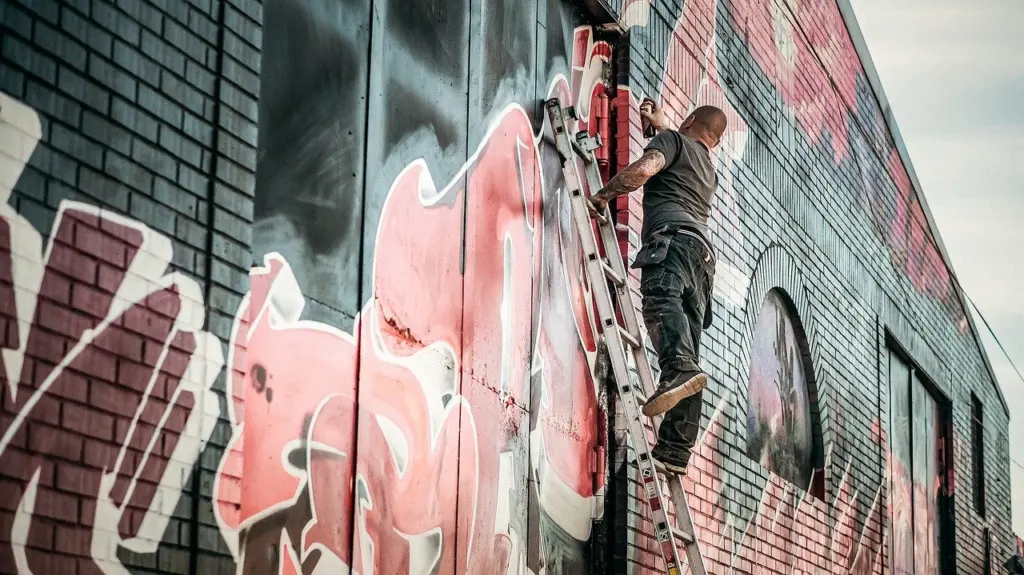
Shepard Fairey was born on February 15, 1970 in Charleston, South Carolina, according to Street Art Bio. Artsper notes that the André the Giant face from his Obey sticker campaign has been stuck more than a million times. It also names a Fairey mural in Paris’s 13th district, a Marianne painted after the 2015 attacks. If you want to see how an image repeated on small surfaces becomes a large public statement, Paris is the place to look for his work.
JR: portraits at wall scale
JR was born in France on February 22, 1983, per Street Art Bio. According to Carré d’Artistes, he covers the walls of the world with huge black and white portraits of anonymous people. His Inside Out project was initiated in 2011 and born of the American TED prize. Since his portraits appear on walls worldwide rather than in one neighbourhood, the sensible way to follow him is by project, not by district.
Keith Haring: subway chalk and public murals
Art in Context describes Keith Haring (1958 to 1990) as a seminal figure in the New York City art scene of the 1980s. Maddox Gallery places his early work on the walls of New York’s subway system, where he chalked radiant babies and barking dogs. His 1986 mural Crack is Wack stands at 128th Street and 2nd Avenue in East Harlem. In 1987 he painted We the Youth in Philadelphia with 14 high school students, a mural Artsper says became world famous. Haring suits anyone who wants murals tied to named street corners and to community collaboration.
Jean-Michel Basquiat: SAMO in lower Manhattan
Maddox Gallery recounts that Jean-Michel Basquiat began tagging cryptic, poetic slogans across lower Manhattan under the alias SAMO in the late 1970s. His early public output was text on walls, not a single landmark mural. That makes him the best case for reading a neighbourhood as an artwork.
How street art entered galleries
The path from the street to the museum is clearest in Haring’s career. Maddox Gallery says his work transitioned seamlessly into galleries and institutions during his lifetime. It also calls Crack is Wack and his collaborations with ACT UP defining examples of art as protest. The street origin did not stop the institutional interest; it was part of the appeal.
Museum records show the result. Art in Context lists Ignorance = Fear, a 1989 offset lithograph, at the Whitney Museum of American Art in New York City. Carré d’Artistes says the greatest cultural venues are snatching up the works of urban artists, naming the Grand Palais, Fondation Cartier, Tate Modern and MOCA in Los Angeles.
This has practical consequences for anyone planning to see the work:
- Go to the wall for context. A mural on a street corner shows the scale, neighbours and surface the artist chose, which a gallery wall cannot reproduce.
- Go to the museum for permanence. A lithograph held by an institution such as the Whitney is a reliable way to see an artist’s line and message when the original outdoor site is hard to reach.
- Combine both for one artist. Haring is the strongest candidate, since his public murals and his museum-held prints sit in the same city.
Planning a route around the names
Decide first whether the trip is built around a person or a place. Both approaches work, but they pull in different directions.
- Follow one city. New York concentrates Haring’s subway and East Harlem work and Basquiat’s lower Manhattan tags in one metropolitan area. That is the most efficient route if you have limited time.
- Follow one artist across cities. Banksy’s Jerusalem wall and Fairey’s Paris mural are in different countries. This suits a longer trip where the artist, not the destination, sets the plan.
- Follow one project. JR’s portraits are tied to a project rather than a district, so start from the project and then work out which city you need.
Methods behind the names
The way each artist works explains why their pieces are found in different ways. Banksy’s prepared stencils, Fairey’s repeated stickers, Haring’s subway chalk drawings, Basquiat’s slogans and JR’s oversized portraits are all different answers to the same problem: how to make an image read quickly in public.
Repetition and scale are the shared tools. A sticker stuck a million times works by accumulation. A black and white portrait on a wall works by size. A chalk drawing works by being passed daily on the same platform. When you look at a piece, ask which of these tools it relies on and whether the surface supports it.
Large public painting also has a longer history than the names above. For the earlier muralist tradition, read Diego Rivera’s Most Famous Murals: 5 Masterpieces That Shaped 20th‑Century Art.
Frequently asked questions
Who are the most famous street artists?
Artsper calls Banksy the most famous street artist in the world. Carré d’Artistes says Shepard Fairey, Banksy and JR make up the top three of the most paid artists, which makes those three the safest starting names.
Do street artists’ works sell for high prices?
Maddox Gallery says Keith Haring’s original works consistently achieve seven-figure results at auction. Artsper adds that in 2018 a silkscreened Banksy version self-destructed a few seconds after an auction sale.
Is there a museum devoted to street art in Paris?
Yes. Carré d’Artistes says a private collector lent a hundred works from his collection to create Art42 in Paris, described as the first street art museum in France.